

How to fill out state ballot papers
There have been changes to Victoria's electoral laws following recent amendments to the Electoral Act 2002. For further information, see our page about the 2026 Electoral Act amendments.
When you vote in a state election, you are voting for who you want to represent you in the 2 houses of the Victorian Parliament:
- the Legislative Assembly (lower house)
- the Legislative Council (upper house).
Lower house ballot paper
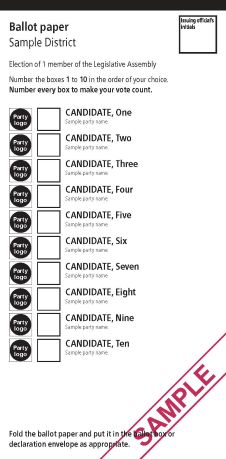
On the smaller lower house ballot paper, you need to number every box in the order of your choice.
- Write the number 1 in the box next to the candidate who is your first choice.
- Write the number 2 in the box next to the candidate who is your second choice.
- Continue writing the numbers 3, 4, 5 and so on until you have a number in every box.
If you are voting in a by-election, this is the only ballot paper you will get.
Upper house ballot paper
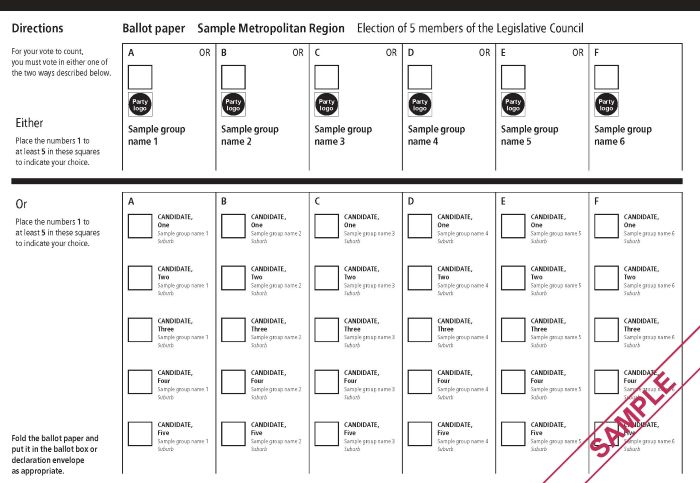
On the larger upper house ballot paper, you can choose to vote above the line or below the line.
Voting above the line
If you choose to vote above the line:
- Write the number 1 in the box next to the group of candidates that is your first choice.
- Write the number 2 in the box next to the group that is your second choice.
- Continue writing the numbers 3, 4, 5 and so on until you have numbered at least 5 boxes.
- Do not write any numbers below the line.
Voting below the line
If you choose to vote below the line:
- Write the number 1 in the box next to the candidate who is your first choice.
- Write the number 2 in the box next to the candidate who is your second choice.
- Continue writing the numbers 3, 4, 5 and so on until you have numbered at least 5 boxes.
- Do not write any numbers above the line.
You can continue numbering more than 5 candidates, but for your vote to be counted you must number at least 5 boxes.
By voting above the line or below the line, you decide your preferences.
Formal and informal votes
A ballot paper that is filled out correctly is known as a formal vote. Formal votes are counted to determine the result of the election.
A ballot paper that has not been filled out correctly is known as an informal vote. Informal votes cannot be counted toward the election result.
A ballot paper may be considered informal if it:
- has ticks, crosses or any other symbol in the boxes
- does not correctly number enough boxes
- misses or repeats numbers
- uses a zero (0)
- is blank.
What is a donkey vote?
A ballot paper that is numbered 1, 2, 3, 4, 5 (and so on) in the same order that the candidates are listed, is known as a ‘donkey vote’.
A donkey vote could:
- be a voter not understanding how to vote
- be a voter not caring how they vote
- express the voter’s true preferences.
If the required number of boxes are correctly numbered, donkey votes are formal and count towards election results.
Making a mistake
If you:
- make a mistake, that is okay. You can cross it out and put the correct number next to it.
- are worried that we will not be able to interpret your corrections, you can return your ballot paper to the election staff and ask for a new one.
- damage or tear your ballot paper, you can return it to the election staff and ask for a new one.